
My name for AI is RAE (Replace and Erase):
AI as a tool for colonization of the writer’s mind
Anya Achtenberg, from Blog and Substack, Writing in Upheaval
My name for AI is RAE (Replace and Erase):
AI as a tool for colonization of the writer’s mind
Anya Achtenberg
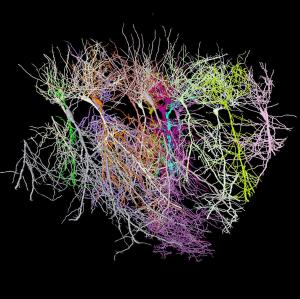
neuronal pathways–“rivers” and “tributaries” along which our associative mind journeys
Good session last week!
Last week I did an Ask-Me-Anything Intro Session to my Writing in Upheaval Blog and my forthcoming workshops: 1. Say it! Dígalo!: The Standalone (write-together) Workshop Series, and, 2. Custom-Made Story, a 10-week intensive course.
This was a discussion and Q & A on writing blocks, story craft, expansion of creativity; potent language, associative maps; un-choking the writing process; with sharing by participants; on writing at this time of upheaval, sorrow, rage, silencing and overwhelm. I’ll be offering a longer workshop on this Writing in Upheaval material, which includes a dozen potent tools and concepts more than useful to work through the silencing and suffocation of this painful and fraught time. (News on this, later.)
From mulling things over for this workshop, and thinking about tools to help writers fulfill their most expansive and exquisite intentions in their writing—the ubiquitous, ever-present creepy stalker AI popped into my head as an anti-tool not to liberate our writing but to steal it, exploit it, occupy and colonize it.
AI produces kill targets, and makes neat bulleted summaries…
The “tool” of AI is used for horrific purposes, such as “producing targets” for the Israeli military to kill and destroy in Gaza and elsewhere with no human oversight (a testament to how inhumane are the forces who rely on it for efficient mass murder). Of course, AI has its seemingly benign purposes, such as summarizing in quick, easy to take in bullet points, a meeting or report (or, uh oh, a book the student will then never read and never engage with in a way that might change or develop their consciousness and critical thinking…whoops, there I go).
But this “little helper” writing tool of AI is something that can step in and short circuit our ideas; and wall in and highway through and blow up our distinct and in ways fragile associative webs, our internal maps that no one else can duplicate. Each of us has, and continues to develop, distinct connections, associations, among objects, places, events, people, ideas, moments…indeed, distinct associations even among our vast and growing collection of words and phrases, which AI cannot plumb.
We’ve been told that an AI “assisted” piece of writing can be an improved and eloquent version of the raw or flawed writing of a distinct human consciousness, with a lot less human effort. What I understand is going on is something actually damaging. That AI assisted or completed piece of writing often locks down that distinct associative wandering which AI cannot see into, in any truly full way. The actual human writer often cannot articulate or at times even indicate the range of the wandering associative mind, because the writer is made aware of this dynamic journey, this live and growing terrain, when engaged—from within the very act of writing, or within the act of deeply reading their own writing.
We know that the very act of writing can help the writer suss out what they are moving toward; where they might arrive; what emotional heart, what intentions, actually organize the story or report or poem. The act of writing for the human allows them to wander about and race along following the sparking connections, which reveals language, story, and understory—the subtext—rising up from within that very human text.
AI-assisted writing as assisted death to the creative writer’s potential?
With AI, what the writer who allows themselves that associative wandering would have written—is wiped out, erased, by an AI replacement.
Let’s say the creative writer, the creative thinker, does not continue on their path, does not surrender to their wandering; but instead surrenders to AI as it charges in to their writing process. AI essentially puts words in their mouth—
AI’s damaging power is to REPLACE THE WORDS THE WRITER MIGHT HAVE DISCOVERED, AND ERASE THE CONNECTIONS TO OTHER BEINGS, PLACES, WORLDS, TIMES, ISSUES, OBJECTS, EMOTIONS, ALL OF IT, that might become part of the story in a revelatory way that only the distinct writer’s consciousness can come to in its journeying.
Yup, AI can write a good story. And erase, replace, kick out, damage, even fill the space in a way that kills the presence of a writer’s distinct consciousness; their language set; their chorus of various ways of speaking; and the presence of other beings/voices/times/concerns inhabiting that writer which would blossom forth in the process of writing, but not necessarily in what they would feed the ravenous AI.
One wouldn’t want to and also can’t train AI or as I call it now, RAE—Replace and Erase—into the full distinctness, the journey in the process of discovery, of the writer’s mind/body/memory consciousness. Yes, they will be taught to feel. But as a distinct creature. Do we still value the human experience and heart?
AI, or RAE—Replace and Erase—is a colonizer
So, it seems, AI, or RAE—Replace and Erase—is a colonizer aiming to wipe out the local culture, language, ancestral knowledge, intergenerational trauma, music, map in the head (an indigenous concept); wipe out the associative maps of each human, maps which are constantly developing, extending the associative reach into what will remain invisible to RAE unless, chillingly, the entire associative activity of the individual writer is moment-by-moment made available through who knows what intrusive bio-technology in service not only to the AI tech bros, but to every colonizing power (human and otherwise) at every level of our existence.
I’m popping these thoughts into Substack on my deep allergy to AI and its power to Replace and Erase the human writer’s distinctness in their work; and how politely it smiles as it colonizes with its ability to kill—in word and in deed—the body, the mind, the memory and dream, the unknown realm of the human’s associative powers and connections; the memories and images which the human writing process makes more available, bringing it up from the unconscious, from ancestral memory, from wherever it comes—and it does not come from AI, but from us; from the earth; from history and blood and ancient song; from actual body love and pain; physical birth and illness and death. Not mimicked. Experienced.
Neruda in Canto General—The General Song—his book-length poem about the history of the Americas—before the brilliant Eduardo Galeano gave us his trilogy Memory of Fire, of the indigenous beginnings of the Americas through the end of the 20th century, in some of the best writing ever in any form—begins with antes—before the European colonizers arrived—and then unfolds the after—the monstrous history of damage brought by the colonizers/thieves/enslavers/ by colonial “religion” and “education”/aiming to wipe out indigenous languages and cultural life—and extinguish with blood “la lampara de tierra—the lamp in the earth.” (“Pero como una rosa salvaje, cayó una gota roja en la espesura, y se apagó una lámpara de tierra.”)
Neruda begins, “Antes de la peluca y la casaca, fueron los rios…”—Before the (soldier’s) helmet and the (priest’s) cassock, there were the rivers…
As, before AI or RAE came to colonize, there were the rivers of association in our minds and our language that we traveled, which brought us to ideas and stories and images and music and words, to what we didn’t even know was there on those river journeys until we come to the river…
Have a listen to Ibeyi on Youtube sing their river song here:
“I will come to your river, wash my soul again…” I can’t stop singing that chorus…
I can’t help but think of AI as colonizer tech being exploited by colonizers with their own plans.
What does “each life is a world” mean? In part, that distinct associative map that continues to grow throughout life…
I believe that the colonization of our minds, our language, our writing, also colonizes our dreams, our distinct associative maps; our liberated wandering in language, in story, in poetry, in a letter to a beloved! by a tool that allows a vast (“Large”, they say) but still limited “language model” to replace our distinct language cosmos, which is able to be mimicked, but only by the interruption and perhaps the destruction of its greatest potential of discovery in truth and beauty that only each human of us (and, likely, the animals, the trees, the winds speaking…) can reach by our associative, experiential, bodily, ancestral, sacred and profane cries and journeys.
Anya Achtenberg, Glasgow, October 6, 2025
 Anya Achtenberg